
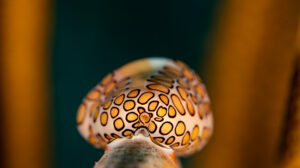
Flamingo Tongue on Cat Tail Coral
On Caribbean dives sites, you may or would have come across some beautiful oranges, whitish hued snails. Most persons believe that the beautiful look of these snails is their shells but end up finding out that the snail’s shell is actually its mantle (its skin). The shell is a plain white shell.
The Flamingo tongue is almost always found on their food source. Their diet varies between different types of soft corals such as sea fans, sea plums, whip corals and other types of soft corals. Female adult Flamingo Tongues attached their sticky eggs to the coral where they live. After about 10 days, the eggs hatch and the juveniles are planktonic.
After some time, they settle onto a gorgonian (soft coral). When adults eat, they eat the polyps off the coral with their radula. The polyps can regrow, so the predation is generally not lethal to the coral. Predators of the flamingo tongue is not a lengthy list; however, they include lobsters, hogfish, pufferfish, because the Flamingo Tongue possess toxins. If not, the Flamingo Tongue will rapidly take over the soft corals on the reef.
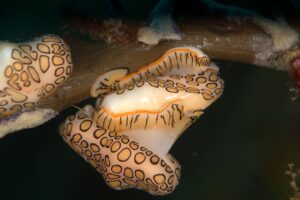
Flamingo Tongues Mating